


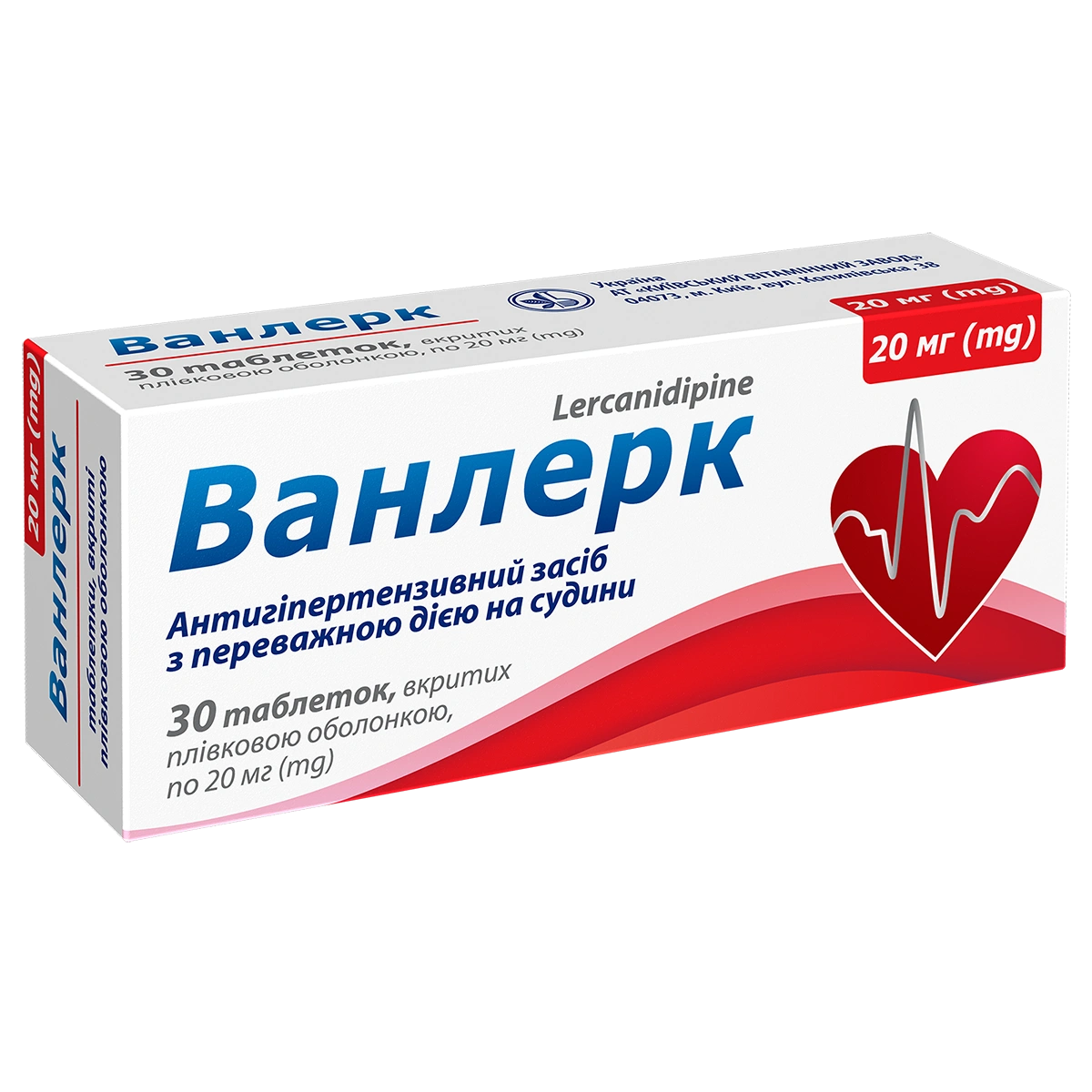
Vanlerc


Essential hypertension of mild or moderate severity.
 Compendium
 Tabletki.ua
 LIKI24
Information about medications intended exclusively for doctors and pharmacists.
PACKAGE LEAFLET
Information for the medical use of the medicinal product
VANLERK
(VANLERK)
Composition:
active substance: lercanidipine;
1 tablet contains 10 mg or 20 mg of lercanidipine hydrochloride, equivalent to 9.4 mg or 18.8 mg of lercanidipine;
excipients: lactose monohydrate; microcrystalline cellulose; sodium starch glycolate (type A); povidone; magnesium stearate;
film coating (for the 10 mg tablets): Opadry II Yellow film-coating mixture: hypromellose (hydroxypropyl methylcellulose); lactose monohydrate; titanium dioxide (E 171); triacetin; yellow iron oxide (E 172);
film coating (for the 20 mg tablets): Opadry II Pink film-coating mixture: hypromellose (hydroxypropyl methylcellulose); lactose monohydrate; titanium dioxide (E 171); triacetin; red iron oxide (E 172).
Pharmaceutical form. Film-coated tablets.
Basic physical and chemical properties:
10 mg tablets: round, biconvex, film-coated tablets, yellow in colour, with a score line on one side;
20 mg tablets: round, biconvex, film-coated tablets, pink in colour, with a score line on one side.
Pharmacotherapeutic group. Selective calcium channel blockers with predominantly vascular effects. Dihydropyridine derivatives. ATC code C08CA13.
Pharmacological properties
Pharmacodynamics
Lercanidipine is a calcium antagonist of the dihydropyridine class. It inhibits the transmembrane influx of calcium into cardiac myocytes and vascular smooth muscle cells. The mechanism of its antihypertensive action is due to a direct relaxant effect on vascular smooth muscle, thereby reducing total peripheral vascular resistance. Despite its short plasma half-life, lercanidipine has a prolonged antihypertensive action because of its high membrane partition coefficient. Because of its high vascular selectivity, the product has no negative inotropic effect. Acute hypotension with reflex tachycardia rarely occurs because of the gradual onset of vasodilation with lercanidipine.
As with other asymmetric 1,4-dihydropyridines, the antihypertensive activity of lercanidipine resides mainly in its S-enantiomer.
The clinical efficacy and safety of lercanidipine 10–20 mg once daily were studied in a double-blind, placebo-controlled clinical trial (1200 patients received lercanidipine, 603 patients received placebo), as well as in actively controlled and uncontrolled long-term clinical trials involving a total of 3676 patients with hypertension.
Most of the studies enrolled patients with mild to moderate essential hypertension (including elderly patients and patients with diabetes mellitus), who received lercanidipine either as monotherapy or in combination with ACE inhibitors, diuretics or beta-blockers.
In addition to the clinical trials conducted to support the therapeutic indication, a further small, uncontrolled but randomised study of the product in patients with severe hypertension (mean ± standard deviation diastolic blood pressure of 114.5 ± 3.7 mmHg) demonstrated normalisation of blood pressure in 40 % of 25 patients receiving lercanidipine hydrochloride 20 mg once daily, and in 56 % of 25 patients receiving lercanidipine hydrochloride 10 mg twice daily. In a double-blind, randomised, placebo-controlled study in patients with isolated systolic hypertension, lercanidipine effectively lowered systolic blood pressure from a mean baseline value of 172.6 ± 5.6 mmHg to 140.2 ± 8.7 mmHg.
No clinical studies have been conducted in the paediatric population.
Pharmacokinetics
Absorption. Lercanidipine is completely absorbed after oral administration of a 10–20 mg dose; maximum plasma concentrations (Cmax) of 3.30 ng/ml ± 2.09 SD and 7.66 ng/ml ± 5.90 SD, respectively, are reached at approximately 1.5–3 hours.
The two enantiomers of lercanidipine show a similar plasma level profile: time to maximum plasma concentration (tmax) is the same, while Cmax and the area under the plasma concentration–time curve (AUC) are, on average, 1.2 times higher for the S-enantiomer; the half-life of the two enantiomers is essentially the same. No interconversion of the enantiomers has been observed in vivo.
Because of extensive first-pass hepatic metabolism, the absolute bioavailability of lercanidipine taken orally after food is approximately 10 %, although it fell to about one-third of this value when the product was taken while fasting. If the product is taken within 2 hours of a very high-fat meal, its bioavailability increases fourfold. Lercanidipine should therefore be taken before meals.
Distribution. Distribution from plasma into tissues and organs is rapid and extensive. Plasma protein binding of lercanidipine exceeds 98 %. Since plasma protein levels are reduced in patients with severe renal or hepatic impairment, the free fraction of the product may be increased.
Biotransformation. Lercanidipine is extensively metabolised by the CYP3A4 isoenzyme; unchanged product is not detected in urine or faeces. It is converted mainly into inactive metabolites, and approximately 50 % of the administered dose is excreted in the urine.
In vitro experiments with human liver microsomes indicate that lercanidipine mildly inhibits CYP3A4 and CYP2D6 at concentrations 160-fold and 40-fold higher, respectively, than its plasma Cmax achieved after a 20 mg dose. Furthermore, drug-interaction studies in humans have shown that lercanidipine in plasma does not alter the levels of midazolam, a typical CYP3A4 substrate, or of metoprolol, a typical CYP2D6 substrate. Thus, at therapeutic doses, lercanidipine is not expected to affect the biotransformation of medicinal products metabolised by CYP3A4 or CYP2D6.
Elimination. Elimination occurs mainly via biotransformation. The mean terminal half-life is 8–10 hours, while the therapeutic effect lasts 24 hours because of the high degree of binding of lercanidipine to cell membrane lipids. No accumulation was observed on repeated dosing.
Linearity/non-linearity. After oral administration of lercanidipine, plasma concentrations are not directly proportional to the dose administered (non-linear kinetics). Following 10 mg, 20 mg and 40 mg doses, the observed maximum plasma concentrations were in a ratio of 1:3:8, and the AUC values in a ratio of 1:4:18, indicating progressive saturation of first-pass metabolism. Thus, the bioavailability of lercanidipine increases with increasing dose.
Additional information in special populations
The pharmacokinetics of lercanidipine in elderly patients and in patients with mild to moderate renal or hepatic impairment have been shown to be similar to those observed in the general patient population. In patients with severe renal impairment, or those on dialysis, plasma concentrations of the product were higher (by approximately 70 %). In patients with moderate to severe hepatic impairment, the systemic bioavailability of lercanidipine is likely to be increased, since it is metabolised mainly in the liver.
Clinical particulars
Indications
Mild to moderate essential hypertension.
Contraindications
Hypersensitivity to lercanidipine or to any other component of the medicinal product;
left ventricular outflow tract obstruction;
untreated congestive heart failure;
unstable angina or recent (within 1 month) myocardial infarction;
severe hepatic impairment;
severe renal impairment (creatinine clearance < 30 ml/min), including patients on haemodialysis;
concomitant use with potent CYP3A4 inhibitors, ciclosporin, grapefruit or grapefruit juice.
Interaction with other medicinal products and other forms of interaction
Contraindicated concomitant use
CYP3A4 inhibitors. Lercanidipine is metabolised by the CYP3A4 enzyme, so inhibitors and inducers of this enzyme taken concomitantly with lercanidipine may affect its metabolism and elimination. Interaction studies of lercanidipine with the potent CYP3A4 inhibitor ketoconazole demonstrated a significant increase in plasma lercanidipine levels (a 15-fold increase in AUC and an 8-fold increase in the maximum concentration of the S-lercanidipine eutomer).
Concomitant use of lercanidipine with CYP3A4 inhibitors (ketoconazole, itraconazole, ritonavir, erythromycin, troleandomycin, clarithromycin) should be avoided.
Ciclosporin. Concomitant use of lercanidipine and ciclosporin increases the plasma levels of both substances. Studies have shown that administration of ciclosporin 3 hours after lercanidipine did not change plasma lercanidipine levels, while the ciclosporin AUC increased by 27 %. However, concomitant administration of lercanidipine and ciclosporin results in a 3-fold increase in plasma lercanidipine levels and a 21 % increase in the ciclosporin AUC.
Ciclosporin and lercanidipine should not be used together.
Grapefruit or grapefruit juice. As with other dihydropyridines, the metabolism of lercanidipine is slowed by grapefruit juice, resulting in increased systemic availability of lercanidipine and an enhanced hypotensive effect. Lercanidipine and grapefruit or grapefruit juice should not be taken together.
Concomitant use not recommended
CYP3A4 inducers. Lercanidipine should be used with caution together with CYP3A4 inducers, such as anticonvulsants (phenytoin, phenobarbital, carbamazepine) and rifampicin, because of the possible reduction in the antihypertensive effect of lercanidipine. In such cases, more frequent monitoring of blood pressure is recommended.
Alcohol. Alcohol consumption should be avoided because of the possible potentiation of the vasodilatory effect of antihypertensive medicinal products.
Interactions requiring dose adjustment
CYP3A4 substrates. Caution should be exercised when lercanidipine is used concomitantly with other CYP3A4 substrates, such as terfenadine, astemizole, or class III antiarrhythmics such as amiodarone, quinidine, sotalol.
Midazolam. Concomitant administration of lercanidipine 20 mg and midazolam in elderly volunteers increased the absorption of lercanidipine (by approximately 40 %) and reduced its rate of absorption (tmax increased from 1.75 to 3 hours). Midazolam concentration was unchanged.
Metoprolol. Concomitant use of lercanidipine with metoprolol, a beta-blocker excreted predominantly via the liver, does not alter the bioavailability of metoprolol but reduces the bioavailability of lercanidipine by 50 %. This effect is possibly due to a reduction in hepatic blood flow caused by beta-blockers, and may therefore occur with other agents of this class. Lercanidipine can therefore be used with beta-blockers, but dose adjustment may be required.
Digoxin. No evidence of a pharmacokinetic interaction was found on concomitant administration of lercanidipine 20 mg in patients on stable beta-methyldigoxin therapy. However, an average 33 % increase in digoxin Cmax was observed, while AUC and renal clearance were not significantly changed. Patients receiving concomitant digoxin should be closely monitored for signs of digoxin toxicity.
Concomitant use with other medicinal products
Fluoxetine. An interaction study of concomitant use with fluoxetine (a CYP2D6 and CYP3A4 inhibitor) in patients aged 65 ± 7 years (mean ± SD) did not reveal any clinically significant change in the pharmacokinetics of lercanidipine.
Cimetidine. Concomitant administration of cimetidine 800 mg per day does not cause a significant change in plasma lercanidipine concentration, but caution should be exercised at higher doses because of the possibility of increased bioavailability and antihypertensive effect of lercanidipine.
Simvastatin. When lercanidipine 20 mg was co-administered with simvastatin 40 mg, the lercanidipine AUC was not significantly changed, while the simvastatin AUC increased by 56 % and the AUC of its active β-hydroxy-acid metabolite increased by 28 %. These changes are unlikely to be of clinical relevance. No interaction is expected between these products when lercanidipine is administered in the morning and simvastatin in the evening, as indicated for that product.
Diuretics and angiotensin-converting enzyme (ACE) inhibitors. Lercanidipine can be used concomitantly with diuretics and ACE inhibitors.
Other medicinal products affecting blood pressure. As with all antihypertensive medicinal products, the hypotensive effect may be enhanced when lercanidipine is used concomitantly with other medicinal products affecting blood pressure, such as alpha-blockers used for the symptomatic treatment of bladder disorders, tricyclic antidepressants, and neuroleptics.
Conversely, a reduced hypotensive effect may be observed with concomitant use of corticosteroids.
Special warnings and precautions for use
Sick sinus syndrome. Lercanidipine should be used with caution in patients with sick sinus syndrome (without a pacemaker fitted).
Left ventricular dysfunction. Although haemodynamically controlled studies did not show impairment of ventricular function, the product should be used with caution in patients with left ventricular dysfunction.
Coronary artery disease. Some short-acting dihydropyridines are thought to increase the risk of cardiovascular complications in patients with coronary artery disease, so lercanidipine should be used with caution in such patients, although it has a prolonged action. Some dihydropyridines may rarely cause precordial pain or angina. Very rarely, an increase in the frequency, duration or severity of these attacks may occur in patients with pre-existing angina. Isolated cases of myocardial infarction may occur.
Peritoneal dialysis. Use of lercanidipine has been associated with cloudiness of the peritoneal dialysis effluent in patients on peritoneal dialysis, due to an increased concentration of triglycerides in the peritoneal effluent. Although the mechanism is unknown, this effect tends to resolve shortly after lercanidipine is discontinued. This relationship should be borne in mind in order to avoid a case of cloudy peritoneal effluent being mistaken for infective peritonitis, leading to unnecessary hospitalisation and empirical antibiotic treatment.
Lactose. Vanlerk contains lactose. Patients with rare hereditary problems of galactose intolerance, total lactase deficiency or glucose-galactose malabsorption should not take this medicinal product.
This medicinal product contains less than 1 mmol (23 mg) sodium per dose, that is to say essentially 'sodium-free'.
Use during pregnancy or breast-feeding
Pregnancy. There is no clinical experience with lercanidipine in pregnancy. Animal studies have not shown a teratogenic effect, although this has been observed with other dihydropyridine compounds. Lercanidipine is not recommended for use in pregnant women or women of childbearing potential unless they are using effective contraception.
Breast-feeding. It is not known whether lercanidipine or its metabolites pass into breast milk. A risk to the infant therefore cannot be excluded. Lercanidipine should not be used during breast-feeding.
Fertility. No clinical data are available on the effect of lercanidipine on fertility. Reversible biochemical changes in the head of spermatozoa, which may affect fertilisation capacity, have been reported in patients treated with calcium channel blockers. In cases of repeated failure of in vitro fertilisation with no other explanation, calcium channel blockers should be considered as a possible cause.
Effects on ability to drive and use machines
The effect of lercanidipine on the ability to drive or use machines is minimal. However, the possibility of dizziness, weakness, fatigue or, rarely, somnolence should be taken into account.
Posology and method of administration
Method of administration
Before taking the product, the following should be noted:
– the product is preferably taken in the morning, at least 15 minutes before breakfast;
– this medicinal product must not be taken with grapefruit juice.
The recommended dose is 10 mg orally once daily, taken no less than 15 minutes before a meal. Depending on the individual patient's response, the dose may be increased to 20 mg.
Dose titration should be gradual, since the maximum antihypertensive effect develops over 2 weeks of treatment.
Patients whose blood pressure is not adequately controlled on antihypertensive monotherapy may be offered the addition of Vanlerk to a treatment regimen with beta-blockers (atenolol), diuretics (hydrochlorothiazide) or ACE inhibitors (captopril or enalapril).
Since the dose–response curve reaches a plateau in the 20–30 mg dose range, it is unlikely that efficacy will be increased by a higher dose, whereas the risk of adverse reactions may increase.
Elderly patients
Pharmacokinetic and clinical data indicate that lercanidipine can be used in elderly patients without special dose adjustment, but treatment in elderly patients should be started under medical supervision.
Patients with renal or hepatic impairment
In patients with mild to moderate renal or hepatic impairment, treatment with Vanlerk should be started under supervision. The usual recommended dose of 10 mg is generally well tolerated by patients in these subgroups; an increase in dose to 20 mg requires caution.
In patients with hepatic impairment, an increase in the antihypertensive effect of the product is possible, requiring dose adjustment.
Lercanidipine is contraindicated in patients with severe hepatic impairment or severe renal impairment (creatinine clearance < 30 ml/min), including patients on haemodialysis.
Paediatric population
The safety and efficacy of this medicinal product in children under 18 years of age have not been studied; no data are available on use in children.
Overdose
During post-marketing use, a number of cases of overdose have been reported (ranging from 30–40 mg to 800 mg, including one suicide attempt).
Symptoms. As with other dihydropyridines, overdose with lercanidipine would be expected to result in excessive peripheral vasodilation with marked hypotension and reflex tachycardia. However, at very high doses, peripheral selectivity may be lost, which may cause bradycardia and a negative inotropic effect. The most common adverse reactions associated with overdose are hypotension, dizziness, headache and palpitations.
Treatment. In severe hypotension, active cardiovascular support should be instituted, including frequent monitoring of cardiac and respiratory function, placing the patient in a supine position with the legs raised, and monitoring of circulating fluid volume and diuresis. Given the prolonged pharmacological action of lercanidipine, cardiovascular monitoring should be continued for at least 24 hours in cases of overdose. Because lercanidipine is highly protein-bound, dialysis is unlikely to be effective. Patients with anticipated moderate or severe intoxication should be monitored in an intensive care setting.
Undesirable effects
According to data from clinical trials and post-marketing experience, the most frequently reported adverse reactions were: peripheral oedema, headache, flushing, tachycardia and palpitations.
The adverse reactions reported during clinical trials and post-marketing use of the product worldwide, for which a causal relationship with the product was considered plausible, are listed below. Adverse reactions are presented according to the MedDRA classification and frequency of occurrence: very common (≥ 1/10), common (≥ 1/100 to < 1/10), uncommon (≥ 1/1000 to < 1/100), rare (≥ 1/10,000 to < 1/1000), very rare (< 1/10,000), not known (cannot be estimated from the available data). Within each frequency grouping, adverse reactions are presented in order of decreasing seriousness.
Immune system disorders: rare – hypersensitivity.
Nervous system disorders: common – headache; uncommon – dizziness; rare – somnolence, syncope.
Cardiac disorders: common – tachycardia, palpitations; rare – angina pectoris.
Vascular disorders: common – flushing; uncommon – hypotension.
Gastrointestinal disorders: uncommon – dyspepsia, nausea, epigastric pain; rare – vomiting, diarrhoea; not known – gingival hyperplasia1, cloudy peritoneal dialysis effluent1.
Hepatobiliary disorders: not known – increased serum transaminases1.
Skin and appendages disorders: uncommon – rash, pruritus; rare – skin eruption; not known – oedema1.
Musculoskeletal, connective tissue and bone disorders: uncommon – myalgia.
Renal and urinary disorders: uncommon – polyuria; rare – pollakiuria.
General disorders and administration site conditions: common – peripheral oedema; uncommon – asthenia, fatigue; rare – chest pain.
1 Adverse reactions from spontaneous reports received during post-marketing use worldwide.
Lercanidipine has no adverse effect on blood glucose or serum lipid levels.
In placebo-controlled clinical trials, peripheral oedema occurred in 0.9 % of patients receiving lercanidipine 10–20 mg, compared with 0.83 % of those receiving placebo. This incidence rose to 2 % in the overall study population, including long-term clinical trials.
Use of some dihydropyridines may occasionally cause precordial pain or angina; in exceptional cases, an increase in the frequency, duration or severity of attacks may occur in patients with angina, and isolated cases of myocardial infarction may be observed.
Reporting of suspected adverse reactions
Reporting suspected adverse reactions after authorisation of the medicinal product is important. It allows continued monitoring of the benefit/risk balance of the medicinal product. Healthcare professionals, as well as patients or their legal representatives, are asked to report any suspected adverse reactions and any lack of efficacy of the medicinal product via the national Automated Pharmacovigilance Information System at: https://aisf.dec.gov.ua.
Shelf life. 2 years.
Special precautions for storage
Store in the original package at a temperature not exceeding 25 °C.
Keep out of the reach and sight of children.
Pack size. 10 tablets per blister; 3 blisters per carton.
Legal status for supply. Prescription only medicine.
Manufacturer. PJSC "KYIV VITAMIN PLANT".
Location of the manufacturer and address of its place of business.
38 Kopylivska Street, Kyiv, 04073, Ukraine.
Information about medications intended exclusively for doctors and pharmacists.