


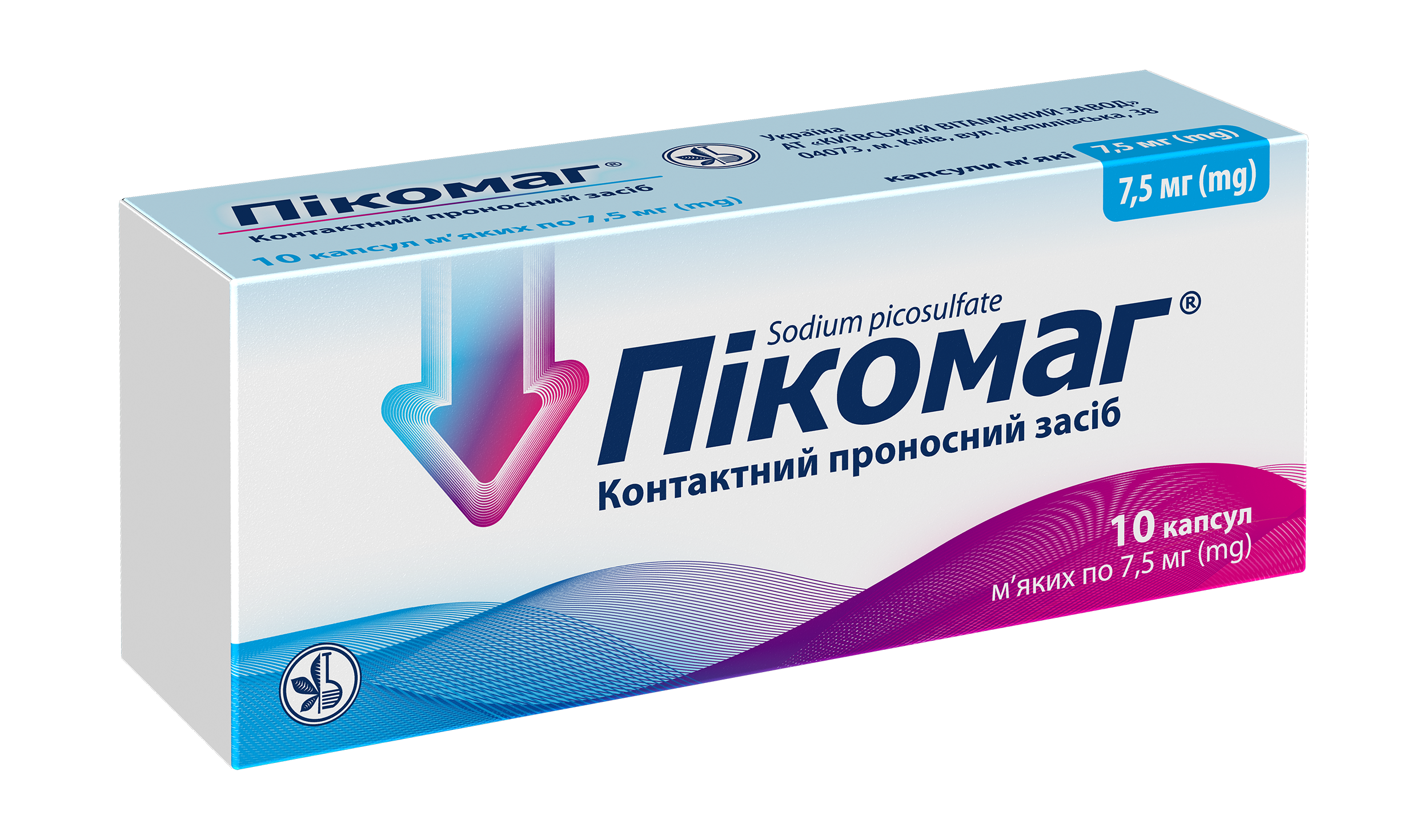
PIKOMAG®
PIKOMAG®

Constipation or conditions requiring relief of defecation.
 Tabletki.ua
INSTRUCTION
for medical use of the medicinal product
PIKOMAG®
(PIKOMAG)
Composition:
active substance: sodium picosulfate;
1 capsule contains 7.5 mg of sodium picosulfate;
excipients: polyethylene glycol (macrogol), glycerol, purified water;
capsule shell: gelatin; liquid sorbitol, partially dehydrated; glycerol; purified water.
Pharmaceutical form. Soft capsules.
Main physicochemical properties: soft gelatin capsules, round, with a seam, transparent, light yellow in colour. The capsule content is a clear, colourless or slightly yellowish viscous liquid.
Pharmacotherapeutic group. Contact laxatives.
ATC code A06A B08.
Pharmacological properties
Pharmacodynamics
Sodium picosulfate, the active substance of the medicinal product Pikomag®, is a locally acting laxative of the triarylmethane group. After bacterial cleavage in the colon it exerts a dual action, stimulating the mucosa of both the colon and the rectum. Stimulation of the colonic mucosa leads to enhanced colonic peristalsis, which promotes the accumulation of water and electrolytes in the colonic lumen. As a result, defecation is stimulated, intestinal transit time is shortened and the stool is softened. Stimulation of the rectum causes increased motility and a sensation of rectal fullness.
Sodium picosulfate acts in the colon and directly stimulates the evacuation of stool. It therefore does not affect digestion or the absorption of calories or essential nutrients in the small intestine.
Pharmacokinetics
Absorption and distribution. After oral administration, sodium picosulfate reaches the colon without significant absorption.
Biotransformation. Sodium picosulfate is converted into the active compound with laxative activity, bis-(p-hydroxyphenyl)-pyridyl-2-methane (BHPM), by bacterial cleavage in the distal segment of the intestine.
Elimination. Only a small portion of BHPM is absorbed after conversion. Following oral administration of 10 mg of sodium picosulfate, 10.4% of the total dose is excreted as BHPM glucuronide in the urine within 48 hours. In addition, BHPM is excreted as the glucuronide in the bile.
Relationship between pharmacokinetics and pharmacodynamics. The onset of action is usually observed 6–12 hours after administration of the medicinal product, depending on the release of the active metabolite (BHPM). The laxative effect of the product does not correlate with plasma levels of the active metabolite.
Clinical particulars
Indications
Constipation or conditions requiring relief of defecation.
Contraindications
Hypersensitivity to the active substance or to any of the excipients of the medicinal product.
Intestinal obstruction.
Severe painful and/or febrile abdominal conditions (e.g. appendicitis) potentially associated with nausea and vomiting.
Acute inflammatory bowel diseases.
Severe dehydration.
Interaction with other medicinal products and other forms of interaction
Concomitant use of high doses of the medicinal product Pikomag® with diuretics or corticosteroids increases the risk of electrolyte imbalance, which may lead to increased sensitivity to cardiac glycosides.
Concomitant use with antibiotics may weaken the laxative action of the medicinal product Pikomag®.
Special warnings and precautions for use
As with other laxatives, Pikomag® should not be used continuously for more than five days without establishing the cause of constipation.
Prolonged daily use of stimulant laxatives may impair bowel function. In patients suffering from chronic constipation, a full diagnostic work-up should be performed and the cause of constipation established. This medicinal product should be used only when a therapeutic effect cannot be achieved by dietary changes or by taking bulk-forming agents.
Prolonged use of the product may lead to water and electrolyte imbalance and to hypokalaemia.
Fluid loss in the intestine may contribute to dehydration. Symptoms may include thirst and oliguria. In conditions associated with water and electrolyte imbalance (e.g. severe renal impairment), the product should be taken under medical supervision.
Discontinuation of the medicinal product may lead to a recurrence of symptoms. If Pikomag® has been used for chronic constipation over a long period, any recurrence of symptoms may be more pronounced.
Cases of dizziness and/or syncope have been reported that coincided in time with the use of sodium picosulfate. The available data suggest that these events are consistent with defecation syncope (associated with the Valsalva manoeuvre) or are related to a vasovagal response to abdominal pain, and are not necessarily related to the action of sodium picosulfate itself.
Stimulant laxatives (including sodium picosulfate) do not help to lose weight. They do not reduce the absorption of calories or nutrients. These agents may cause diarrhoea, abdominal cramps and dehydration. Dehydration may appear as weight loss.
Use during pregnancy or breastfeeding
Pregnancy
Adequate clinical studies in pregnant women have not been conducted. Long-term experience with the product has not revealed any evidence of undesirable or harmful effects during pregnancy.
For safety reasons, the medicinal product Pikomag® should not be used during pregnancy, especially in the first trimester, except where the product is prescribed by a doctor and the expected benefit to the mother outweighs the possible risk to the child.
Breastfeeding
Clinical data indicate that neither the active metabolite bis-(para-hydroxyphenyl)-pyridyl-2-methane (BHPM) nor its glucuronides are excreted into breast milk.
Nevertheless, the medicinal product Pikomag® should not be taken by breastfeeding women, except where the product is prescribed by a doctor and the expected benefit outweighs any risk.
Fertility
Clinical studies of the effect of the medicinal product on fertility in humans have not been conducted. Animal studies have not revealed any effect of the product on fertility.
Effects on the ability to drive and operate machinery
Studies of the effect of the medicinal product on the ability to drive a car and operate other machinery have not been conducted.
However, patients should be warned of the possibility of adverse reactions such as dizziness and/or syncope developing as a result of a vasovagal reaction (in particular, abdominal cramping). If abdominal cramping occurs, the patient should avoid potentially hazardous activities such as driving or operating machinery.
Method of administration and dosage
The medicinal product Pikomag® is to be taken orally. It is recommended to take the capsules at night to ensure bowel movement the following morning. Adults should take 1 capsule (7.5 mg) once daily at night. Do not exceed the maximum recommended daily dose of sodium picosulfate of 10 mg.
Pikomag® should not be used daily or over a prolonged period without establishing the cause of constipation.
Once regular bowel movements have been restored, treatment with the medicinal product can usually be discontinued.
Children
The medicinal product Pikomag® should not be used in children (under 18 years of age).
Overdose
Overdose of the medicinal product may cause loose stools (diarrhoea), abdominal cramps and clinically significant loss of fluid, potassium and other electrolytes.
In case of acute overdose, the consequences may be minimised or avoided by inducing vomiting or by gastric lavage shortly after administration of the product. Fluid replacement and correction of electrolyte balance may be appropriate. Antispasmodics may be used.
Isolated cases of ischaemia of the colonic mucosa have been reported with doses of sodium picosulfate considerably higher than those recommended for the treatment of constipation.
Pikomag®, like other laxatives, may with prolonged overdose lead to chronic diarrhoea and abdominal pain, hypokalaemia, secondary hyperaldosteronism, and to the formation of renal calculi. Long-term laxative abuse has caused renal tubular damage, metabolic alkalosis and muscle weakness resulting from hypokalaemia.
Adverse reactions
Adverse reactions are listed by frequency of occurrence: very common (≥ 1/10), common (≥ 1/100 – < 1/10), uncommon (≥ 1/1000 – < 1/100), rare (≥ 1/10 000 – < 1/1000), very rare (< 1/10 000), not known (cannot be estimated from the available data).
Skin and subcutaneous tissue disorders:
not known: skin reactions (angioedema, drug-induced toxicoderma, rash, pruritus).
Immune system disorders:
not known: allergic reactions.
Nervous system disorders:
uncommon: dizziness;
not known: syncope.
The available information indicates that dizziness and syncope are due to a vasovagal reaction (for example, in response to abdominal cramping or defecation) (see also section "Special warnings and precautions for use").
Gastrointestinal disorders:
very common: diarrhoea;
common: abdominal discomfort, abdominal pain, abdominal cramps;
uncommon: nausea, vomiting.
Prolonged and excessive use of the medicinal product may lead to loss of fluid, potassium and other electrolytes. This, in turn, may cause muscle weakness and impaired cardiac function, especially when the medicinal product is used concomitantly with diuretics or corticosteroids.
Reporting of suspected adverse reactions
Reporting suspected adverse reactions after authorisation of the medicinal product is important. It allows continued monitoring of the benefit/risk balance of the medicinal product. Healthcare and pharmaceutical professionals, as well as patients or their legal representatives, are asked to report any suspected adverse reactions and any lack of efficacy of the medicinal product via the Automated Information System for Pharmacovigilance at: https://aisf.dec.gov.ua.
Shelf life. 3 years.
Storage conditions
Store in the original package at a temperature not exceeding 25 °C.
Keep out of the reach of children.
Package. 10 capsules in a blister; 1 blister in a carton.
Dispensing category. Without prescription.
Manufacturer. JSC "KYIV VITAMIN PLANT".
Location of the manufacturer and address of its place of business
38 Kopylivska Street, Kyiv, 04073, Ukraine.
Date of last revision. 29.05.2026
Advertisement for a medication. Before using this medication, be sure to consult your doctor and read the package insert.